
How to Clean Gold and Diamond Jewellery Safely at Home: An Atelier Guide
Learn the gentle, jeweler-approved method to clean solid gold and diamond jewellery at home. Discover what solutions to avoid, how often to soak, and when to visit our Surat workshop for ultrasonic bench inspection.
Why Diamonds Lose Their Sparkle
Diamonds possess one of the highest refractive indexes in nature (2.417), engineered to capture light and reflect it back to your eye as blinding optical brilliance and rainbow fire.
However, diamonds are naturally lipophilic — meaning they attract oils, lotions, hand sanitizers, and natural skin sebum. Within just a few weeks of daily wear, a microscopic film of oil coats the pavilion facets on the underside of your diamond, blocking light from entering and escaping.
Fortunately, restoring your heirloom to showroom brilliance does not require toxic chemicals or expensive machinery. Here is our master goldsmiths' safe, step-by-step home cleaning routine.
---
The Atelier-Approved Home Cleaning Method
You only need three simple household items:
- A small ceramic or glass bowl of lukewarm warm water (never boiling).
- A few drops of mild, lotion-free dishwashing soap (such as standard Dawn or liquid Castile soap).
- An ultra-soft baby toothbrush (labeled extra-soft).
---
Step-by-Step Cleaning Instructions
Step 1: The Warm Soaking Bath
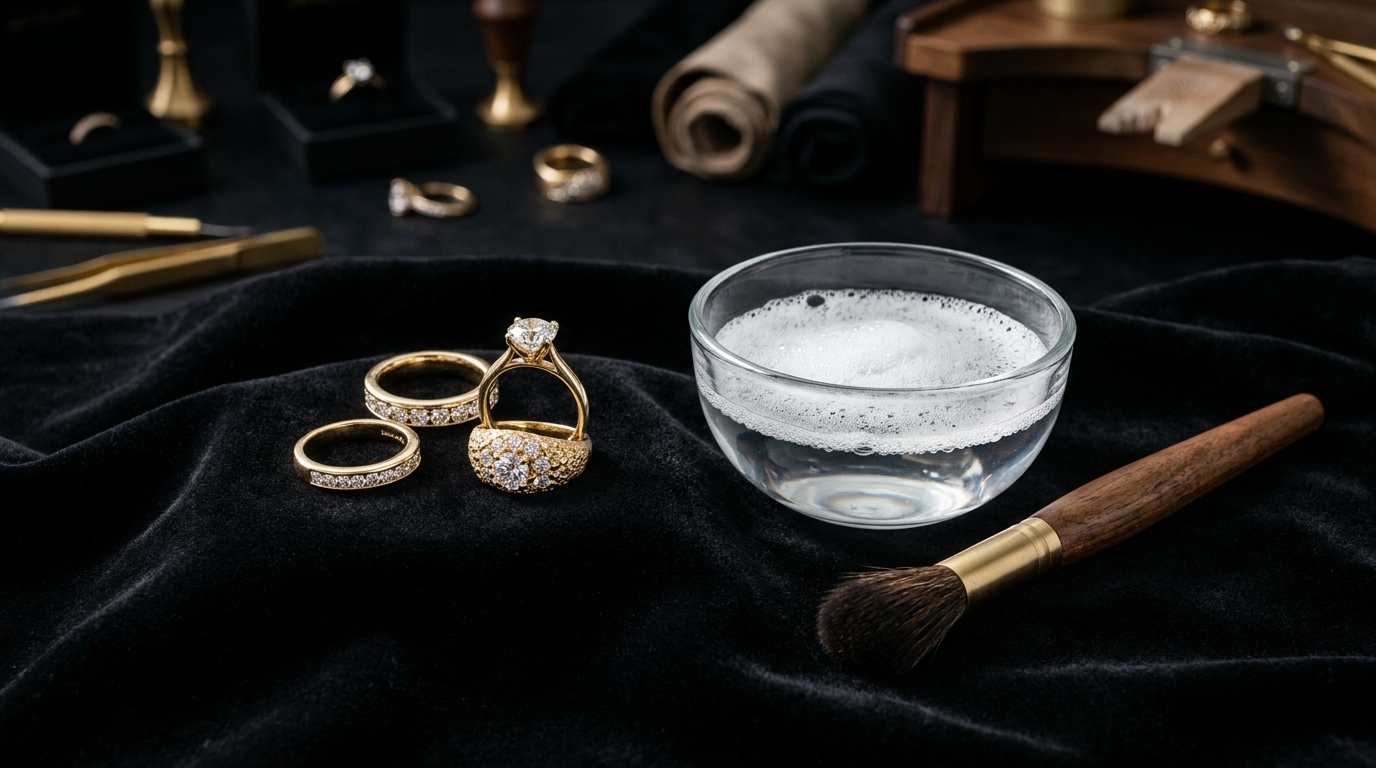
Fill the bowl with lukewarm water and stir in two drops of gentle dish soap until suds form. Submerge your gold rings, earrings, or pendants into the solution for 15 to 20 minutes. The warm soapy water softens hardened oils and lotions trapped in the under-gallery.
Step 2: Gentle Precision Brushing
Remove one piece at a time. Holding the jewel securely over the bowl (never over an open drain!), use the extra-soft baby toothbrush to gently scrub:
- The underside of the basket and pavilion facets, where 90% of grime accumulates.
- The crevices between pavé prongs and eternity bands.
- Around the outer edges of the setting.
Caution: Never apply heavy downward force. Let the soft bristle tips do the work.
Step 3: Clean Rinse
Transfer the piece into a second bowl of clean, lukewarm water to thoroughly rinse away all soapy residue.
Step 4: Lint-Free Pat Dry
Gently pat dry with a clean, lint-free microfiber cloth. Avoid paper towels, which contain wood pulp fibers that can leave micro-scratches on polished gold surfaces.
---
Common Home Cleaning Mistakes to Avoid
| Method / Substance | Risk to Your Jewellery | Better Atelier Alternative |
|---|---|---|
| Toothpaste | Contains abrasive silica that dulls gold luster | Mild liquid dish soap with soft cloth |
| Boiling Water | Can shock gemstones and loosen adhesive settings | Lukewarm comfortable water bath |
| Baking Soda / Bleach | Chemically corrodes copper and zinc alloys in gold | Non-abrasive pH-neutral soap |
| Cheap Home Ultrasonics | High vibration can vibrate small pavé diamonds loose | Professional bench inspection |
---
When to Seek Professional Workshop Care
While home soaking keeps your diamonds clean between outings, we recommend a professional workshop checkup once every 12 to 18 months:
- Prong Tightness Check: Over time, daily contact can nudge claws. Our setters inspect every stone under 40x microscopes to ensure diamonds cannot rotate or wobble.
- Ultrasonic & Steam Blast: Workshop-grade 80 PSI dry steam blows away microscopic particles from hidden CAD galleries without stressing prongs.
- Refinishing & Rhodium Replating: For white gold pieces, a fresh dip in liquid rhodium restores icy brilliance.
"A quick 15-minute soak every fortnight will keep your diamonds dancing in the sunlight exactly as they did on the day you said yes."