
IGI vs GIA: Which Diamond Certificate Matters More in 2026?
Navigating diamond certification in 2026. Compare IGI and GIA grading standards, laser girdle inscriptions, grading fees, and why IGI has become the global gold standard for lab-grown diamond clarity and color verification.
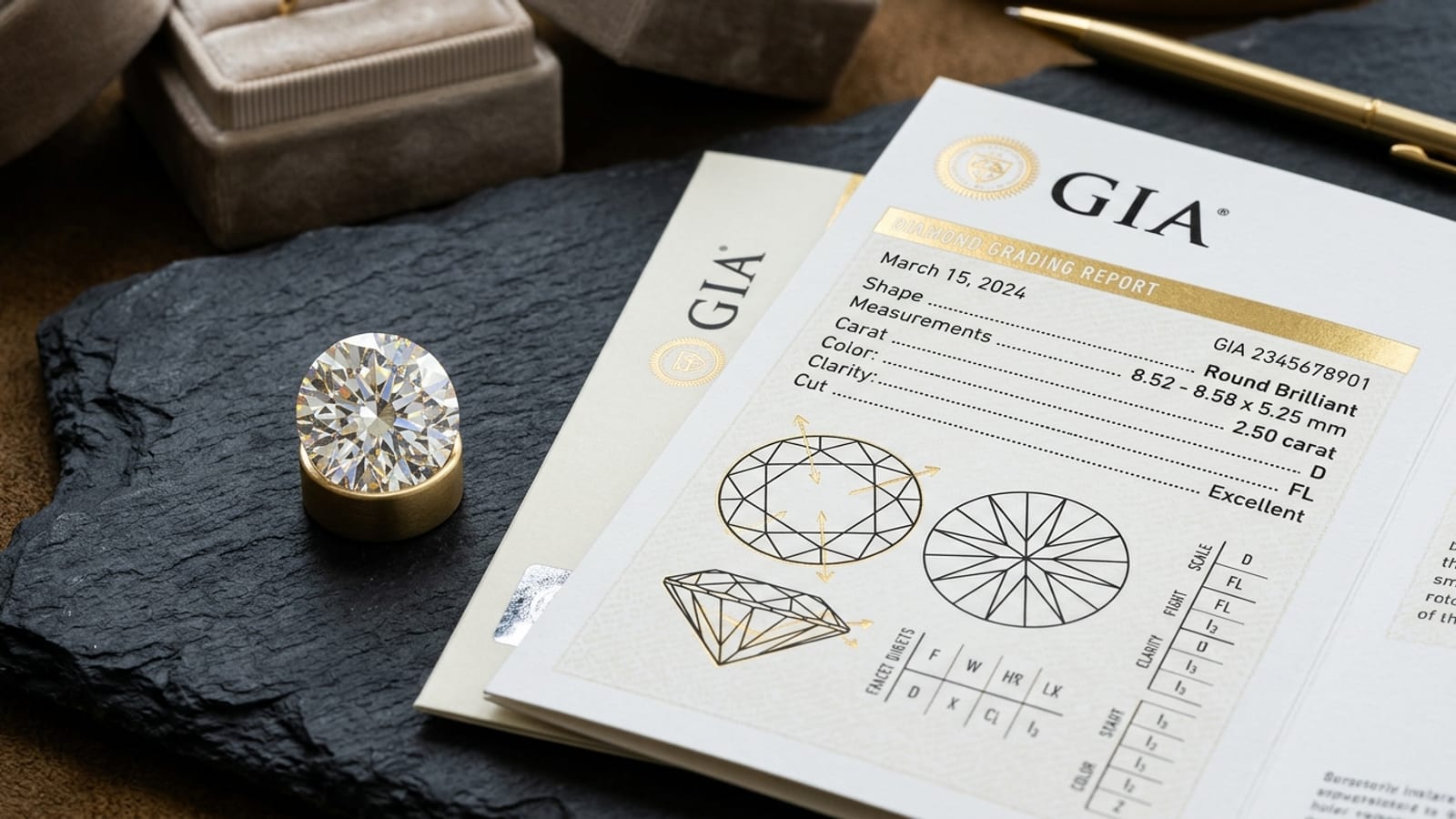
The Importance of Independent Certification
A diamond certificate (or grading report) is the single most vital document accompanying any fine jewellery purchase. It provides unassailable, independent verification of your stone’s 4Cs: Carat Weight, Color, Clarity, and Cut.
In the diamond world, two institutions dominate global recognition:
- GIA (Gemological Institute of America)
- IGI (International Gemological Institute)
For decades, GIA was universally celebrated as the undisputed authority for natural, earth-mined diamonds. However, with the meteoric rise of lab-grown diamonds, IGI emerged as the market pioneer and global standard-bearer.
If you are shopping for a custom diamond ring in 2026, which certification should you look for? Here is our unvarnished, bench-level breakdown.
---
History & Stance on Lab-Grown Diamonds
To understand the difference between IGI and GIA today, it is essential to understand how each institute responded to lab-grown technology over the past decade:
IGI (International Gemological Institute)
- Founded in 1975 in Antwerp, Belgium, with major headquarters in Mumbai and Surat.
- The Pioneer: IGI embraced lab-grown diamonds early (in the mid-2000s) when traditional diamond institutions refused to grade them.
- IGI developed rigorous, full-spectrum grading methodologies for lab diamonds, providing exact Color grades (D, E, F, G, etc.) and exact Clarity sub-grades (VVS1, VVS2, VS1, VS2) identical to mined stones.
- Because of its early commitment and headquarters in the cutting hubs of India and Europe, IGI grades over 80% of all lab-grown diamonds worldwide.
GIA (Gemological Institute of America)
- Founded in 1931 in Carlsbad, California; invented the international 4Cs grading system.
- The Traditionalist: GIA initially viewed lab diamonds with skepticism. Until late 2020, GIA only issued synthetic diamond reports with broad, vague ranges (e.g. "Colorless" rather than D, E, or F; "Very Slightly Included" rather than VS1 or VS2).
- GIA updated its policy in late 2020 to provide specific 4Cs grading for lab-grown stones, but their turnaround times and grading fees remain geared primarily toward multimillion-dollar mined auction stones.
---
Key Comparison: IGI vs GIA for Lab Diamonds
| Criterion | IGI (International Gemological Institute) | GIA (Gemological Institute of America) |
|---|---|---|
| Market Share in Lab Diamonds | Dominant (~80% to 85% of global market) | Growing, but secondary (~10% to 15%) |
| Full 4Cs Grading Specificity | Full specific grades (e.g., E Color, VVS2 Clarity) | Full specific grades (since late 2020) |
| Laser Girdle Inscription | Standard (Inscribes "LG" + unique report number) | Standard (Inscribes "LABORATORY-GROWN" + report number) |
| Grading Cost / Fee | Lower, efficient turnaround | Higher, premium fee added to stone cost |
| Turnaround Time | Fast (7–14 days in Surat/Mumbai hubs) | Longer (3–6 weeks) |
| Global Consumer Acceptance | Universal standard for lab-grown diamonds | Universal standard for earth-mined diamonds |
---
Are IGI Grades Less Strict Than GIA?
A lingering myth in consumer forums suggests that IGI might grade "looser" than GIA by half a color or clarity grade. In reality:
- For Cut Proportions: Both laboratories utilize computerized optical ray-tracing software and proportion analyzers (such as Sarine technology). An "Ideal" or "Excellent" cut measured by IGI meets the identical geometric parameters for table percentage, crown angle, and pavilion depth as GIA.
- Double-Blind Audits: Independent gemmological audits comparing stones graded by both IGI and GIA find over 92% concordance in color and clarity calls.
- Lab Diamond Mastery: Because IGI inspects millions of lab-grown stones each year, their gemmologists are exceptionally adept at identifying subtle synthesis nuances, such as strain patterns in CVD stones or metallic flux in HPHT rough.
---
What to Look for on Your Certificate
Regardless of whether your certificate bears the IGI or GIA crest, make sure it includes these non-negotiable details:
- Unique Report Number: A digital grading number that can be independently looked up on the laboratory's official online verification portal (e.g. igi.org/reports/verify-your-report).
- Laser Inscription Registry: Confirmation that the report number is microscopic laser-etched onto the diamond's outer girdle edge.
- Proportion Diagram: Exact measurements showing Table %, Depth %, Crown Angle, and Pavilion Angle.
- Polish and Symmetry: Both should read Excellent (or Ideal) to ensure maximum fire and zero optical light leakage.
---
The Workshop Recommendation for 2026
- For Lab-Grown Diamonds: Choose IGI. You will receive an impeccably accurate, internationally honored grading report without paying inflated laboratory fees that add zero aesthetic value to your stone.
- For Earth-Mined Diamonds Above 1 Carat: Choose GIA. For mined heritage stones where resale and auction provenance are paramount, GIA remains the historic benchmark.
At The Memorial Jewels, all our certified lab-grown diamond solitaire rings and bespoke pieces are accompanied by official IGI reports with verifiable laser-inscribed girdle numbers, ensuring absolute peace of mind and generational authenticity.